|
|
|
The Mandinka People
Wellspring operates primarily in the Casamance region located in southern Senegal. The majority of the people in the Casamance are Mandinka, although there are other smaller people groups represented as well.
|
|
What Are Their Lives Like?
|
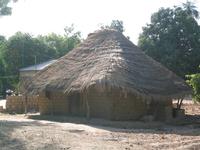
One of the most striking observations that we have made when living and working among the people in Senegal, West Africa, is the oppressive poverty so pervasive throughout the country. Most people live in mud brick huts with grass thatch roofs with no access to electricity or clean drinking water, and very often not enough food to feed their families. Mothers and fathers are often faced with terrible decisions such as whether or not they should sacrifice the money needed to buy food so that the family can purchase medicine needed to treat a child with malaria, who may die otherwise.
|
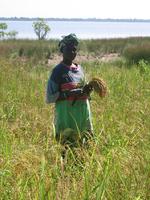
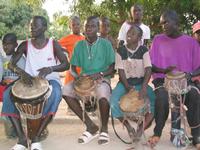
Mandinka culture is rich in tradition, music, and spiritual ritual. Most of the Mandinka are farmers. Rice, millet, sorghum, and peanuts are their staple crops. While they raise most of their own food, some products are obtained through trade and some are gathered from the forests. During planting and harvesting seasons, much time is spent in the fields. Others raise goats, sheep and chickens. Cattle are sometimes kept, but only to gain prestige, to use as ritual sacrifices, or to use as a "bride price." With a part time job, the average annual income for a Mandinka male is only $130.
|
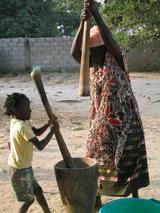
Mandinka villages are made up of clans, or family groups all having the same name. The men do the heavy farm work, hunt, and fish, while the women cook, clean, collect water, care for the children, and work in the rice fields. They also help the men gather produce from the forests.
Traditionally, parents arranged their daughters' marriages while the girls were still infants. Today, marriages are still arranged, but not as early. The groom is required to work for the bride's family both before and after the wedding. He must also pay the girl's family a "bride price." Unlimited polygamy is permitted among the Mandinka, but the men rarely have more than three wives.
|
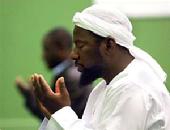
Islam was first introduced to the Mali Empire by foreign merchants. Gradually, Islam was blended with their traditional beliefs, which involved worshipping the spirits of the land. Today, it is not uncommon for someone to first pray in the village mosque, then sacrifice a chicken to the "village spirit."
Most of the Mandinka observe Islamic rituals and view Allah as being the one supreme god. However, they also see him as inaccessible and little concerned with the daily affairs of his creation. Many of the Mandinka consult marabouts (Muslim "holy men") for healing, protective amulets, or insight into the future. The most important holiday in Senegal is the Celebration of Tobaski, in which the head of every family is required to sacrifice a ram in remembrance of the story of Abraham and Isaac.
|
Life in Senegal is difficult. In rural areas, there are problems with drought and famine, as well as periodic plagues of locusts. Overuse of the farmland has also caused the soil to lose its fertility. Wells often go dry for weeks or even months before the inadequate annual rainfall replenishes the water table.
|
Only 10% of the Mandinka are literate. Because of this, the Mandinka have a rich oral history that is passed down through praise singers or griots. Until very recently, Mandinka was only an oral language and there were no written resources. However, Wellspring has been able to provide Mandinka language books to many people and is planning a literacy project to teach people how to read and write in their own language. The Mandinka people Wellspring is working with have been amazed at the fact that their language is written down somewhere after seeing it for the first time and have expressed great interest in learning to read.
|
|
|
|
|
|
|